

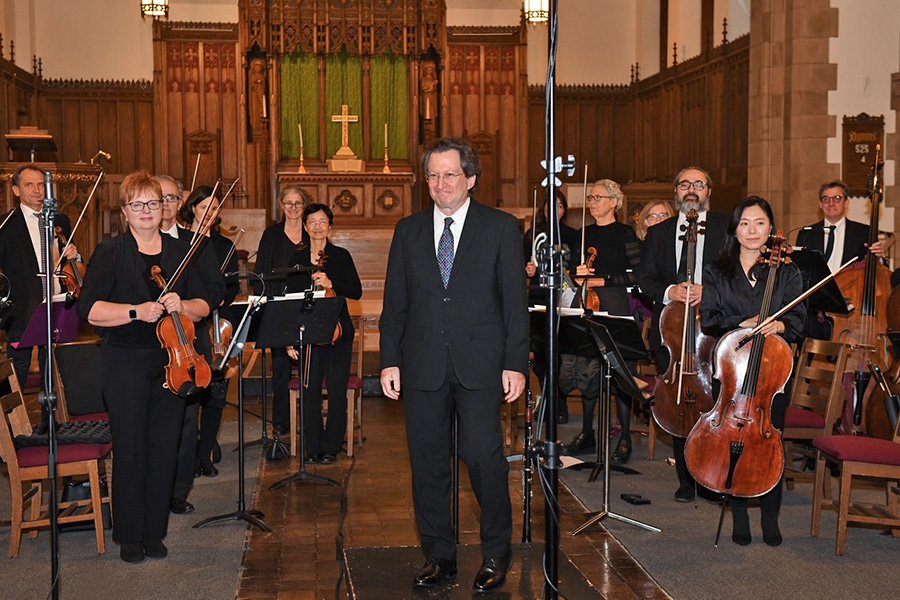
In his opening remarks, Steven Lipsitt, founding conductor of the Bach, Beethoven & Brahms Society, said that Sunday’s concert at United Parish Church in Brookline was about “comfort and peace,” two conditions that humans want desperately but often fail catastrophically to attain. However, on this particular fall afternoon, there was no failure; performances and the music—all for string ensemble and voices—delivered what was promised and then some.
J.S. Bach was the focal point of the first half, which opened with the air from his Third Orchestral Suite, rendered with a tempo and phrasing that turned what is usually played as a solemn ode into an elegant and lyrical dance, deftly handled by the ensemble. The subtle briskness served the piece well and would have also benefited their take on the gavotte from the same suite that was played third on the program. Here, the performers seemed a bit bogged down, though the clever addition of Lipsitt himself playing the obligato trumpet part on the clarinet lent a cheery brightness that made up for it somewhat.
Between the two parts of the suite, the audience was treated to one of the less-often-heard works on the program, Fancy on a Bach Air by American composer John Corigliano. Based on the Aria from Bach’s Goldberg Variations, this mournfully uplifting piece gives one the sense of looking across green fields at dusk while longing for something lost, a mood captured effectively in this performance.
We then heard an air and a gavotte from a larger suite by Arthur Foote, one of the “Boston Six,” (also known as the second Boston School) a collective of New England composers who formed a sort of stylistic bridge between Old World aesthetics and Americana flavors. It was clear that Foote’s air is more than just inspired by Bach’s that opened the show, its structure and phrasing being a near match. The gavotte is also created in the old man’s shadow; though part way through, it bursts into a lively pseudo-country-dance, played here with gentle verve.
The last two pieces on the first half were perhaps the least known and the most fascinating. French composer Lili Boulanger’s Pie Jesu, written in the year of her untimely death of tuberculosis at age 25, is a work of dark-hued harmonies and pleading chromatic scales that support an almost childlike setting of the Latin text. Soprano Carley DeFranco delivered the part with a voice that is rich and resonant but also just vulnerable enough to capture the music’s yearning nature. Beautifully conceived and filled with lush late-Romantic harmonies, Passacaglia and Fuga by Czech composer Hans Krása, also written in the year of his death at the hands of the Nazis, features eclectic string techniques and dense counterpoint that, but for a couple of slips, Lipsitt and the ensemble deftly executed.
The second half opened with a somewhat understated performance of Samuel Barber’s Adagio for Strings. It was appropriately placed, however—especially for those of a certain age that have an indelible association between it and Oliver Stone’s anti-war film “Platoon”—as it was followed by what was really the centerpiece of the entire concert, Peace Cantata, by contemporary Boston composer Howard Frazin. This three-part work intersperses quotes by 20th-century Jewish philosopher and peace activist Abrahm Joshua Heschel. Frazin’s setting of these quotes, at once lyrical and declamatory, were delivered by baritone Keith Phares with a powerful and moving grace that filled the sanctuary with bright warmth. Part One features William Butler Yeat’s “The Second Coming,” sung with emotive depth by mezzo-soprano Krista River. In Part Two, Wilfred Owen’s “Anthem for a Doomed Youth” is cast in a moving duet for mezzo and baritone, alluringly delivered by River and Phares. Both settings demonstrate Frazin’s penchant for taking words that, on the surface, express stress and ugliness and turning them into something oddly but convincingly lovely. DeFranco joined the other two singers for Part Three in a liltingly expressive dona nobis pacem, their flawlessly blended voices supported by the same straightforward but effective string writing that the composer uses throughout the work.
For an encore, Lipsitt sat down at the piano to accompany the three singers in Barber’s “Sure on This Shining Night.” It made a fitting conclusion to a program that left us all feeling just a little bit better about humanity.