
The internationally renowned husband and wife piano duo of Alessio Bax and Lucille Chung wowed a full house Saturday night for the July 5th opening of the 56th Newport Classical Music Festival in the historic Breakers Mansion. After a brief welcome from Newport Classical Board President Susanna Laramee and Rhode Island Governor Dan McKee thanking Newport Classical for its year-round engagement reaching over 2,500 students through in-school workshops, free community concerts, and yearly commissions of new works from composers who are shaping the future of classical music, Bax and Chung took to the stage welcoming us with the delightful and exuberant finale of Mozart’s Concerto in F Major, K. 459 in the transcription titled Duettino concertante nach Mozart, BV B 88 of Ferruccio Busoni. Rather than merely reducing the orchestra part to a second piano, Busoni applied his creative genius and true affection for Mozart to the whole of the score, recasting the entire texture into a playful and imaginative dialogue between the two pianos, while respecting the integrity of the original concerto, with only sparse additions and interpolations. These took form as occasional sequenced extensions of episodic passages and small and subtle interpolations where Mozart himself may have added a small, embellished phrase (often marked by a fermata sign over a rest, called an ‘Eingang’).
Bax and Chung delivered with dash and clarity, wedding the classical purity of Mozart’s style in the bravura passages with a more romantic tint to the lyrical and tender melodies, which was more reminiscent of the romantic Busoni. The cadenza was entirely a Busoni creation, still presented as a dialogue but marked by thicker textures and darker sonorities, a brief excursion into Busoni’s world before returning to the gaiety of Mozart’s light-hearted closing bars, echoing a theme familiar to opera lovers as Papageno’s theme, also a duet, from The Magic Flute. Mozart frequently used his own melodies on more than one occasion, this one first appearing in his very first Symphony, written when the composer was eight years of age.
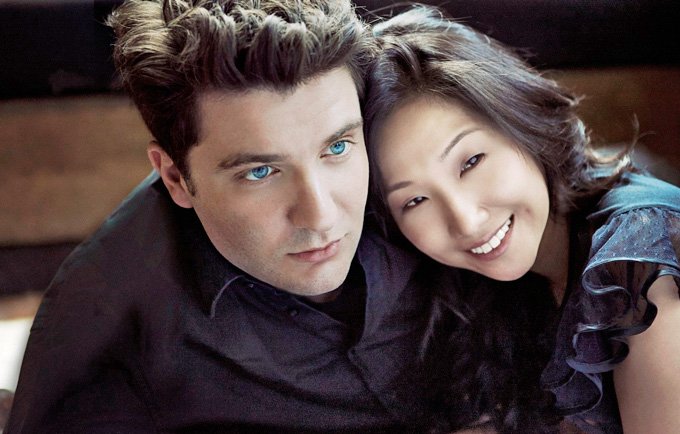 The true and rare delight of the evening, though, was the Concerto for Two Pianos by Poulenc Written in 1932, this alluring piece is filled with color, brilliance and light-hearted charm. Poulenc was a master of satire and parody and was influenced by the surrealist poets of his time but also had a deep respect for Mozart and Bach on the one hand, and Ravel and Stravinsky on the other. While everyone is familiar with Impressionism (exemplified in music by Debussy and early Ravel), the post-Impressionist period is harder to define with its competing styles, ideas, and all manner of “-isms” in unsettling times of flux and change, often trying to juxtapose the old with the new. Thus, one can hear many competing voices in the music of Poulenc, the opening staccato chords with their brusque and sharp added dissonances à la Stravinsky, the dream-like sequences recalling Prokofiev’s Visions fugitives and similar passages from his violin and piano concertos, the bell-like tones and echoes of Balinese gamelan music Poulenc heard at the 1931 World’s Fair held in Paris. Poulenc specifically mentioned his indebtedness to Mozart in a letter when he crafted the second movement theme after the second movement of Mozart’s Piano Concerto in D Minor, K. 466, a gently lilting Romance. In this concerto, though, the Mozartian theme quickly gives way to a more sweeping and lush line that his been compared to Rachmaninoff, while the final movement is playful and jazzy, recalling Gershwin and the Piano Concerto in G Major of Ravel, which premiered the same year. Of course, what one hears most, if one is familiar with the music of Poulenc, is the composer himself. The sparse textures, bright colors, and gently expressive lyricism of the more tender melodies recall the Sextuor for wind instruments also written in 1932, the galloping passages and circus-like atmosphere of the outer movements recalling similar passages from the Allegro sections of the Concerto for Organ, Strings, and Tympani in G Minor, and those uplifting lines that foreshadow the serene extasy of the conclusion of the Gloria arrived in vivid colorings, subtle voicings, and dynamic pianism; the couple fused as one harmonious entity. In this riveting traversal, one almost forgot the missing orchestra, though one would prefer to hear this duo with the small chamber orchestra Poulenc expected, replete with colorful winds sparkling percussion, and the aesthetic sweep of strings.
The second half began at one piano with Schubert’s Fantasie in F Minor (1828) for piano four hands, D. 940. They handled this introspective work with elegance and dignity, warmth of expression, and subtle awareness of voicing and the dramatic power of breath and space, in a panoply of brilliant pianism and artistic depth. Lighter fare followed, with two four-hand transcriptions of piano pieces by Debussy: The Girl with the Flaxen Hair and the evocative La plus que lente (The More than Slow). The evening closed with three of Piazzolla’s Tangos as arranged by Bax and Chung: Lo que vendrà, Milonga del Angel, Libertango. These came across with the pure abandon and romantic freedom that marked Piazzolla’s own live performances with his group.
The Festival continues this week with pianist Sara Davis Buechner at Castle Hill on Tuesday July 8th in a program of American composers juxtaposed with Ravel and Poulenc, and on Wednesday July 9th of piano quartets of Mozart, Kiel, and Brahms at the Elms in the morning and the ensemble Twelfth Night performing Handel, Pisendel, Fasch, and Vivaldi at the Breakers Mansion in the evening. View the full season HERE.