
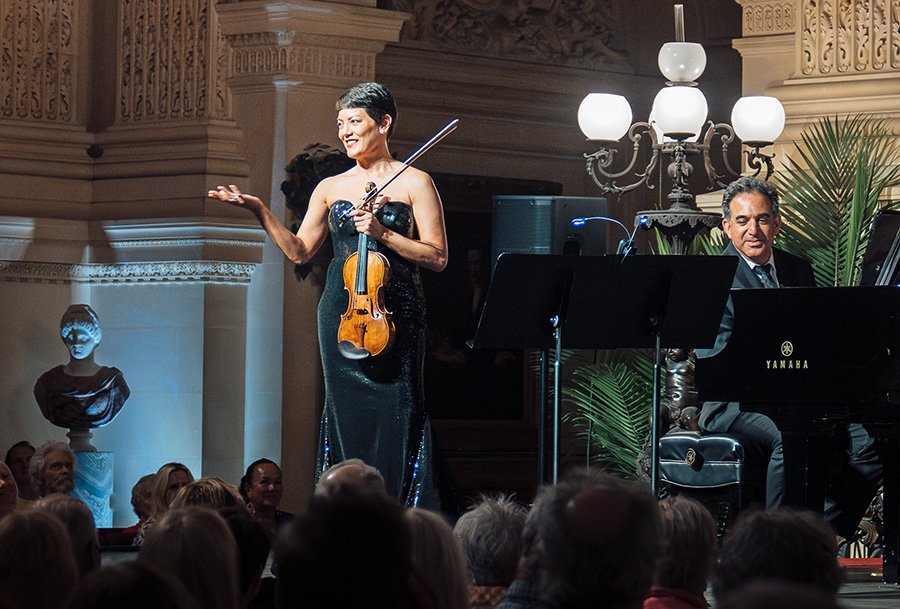
Newport Breakers Mansion resonated Sunday evening with the sparkle and romance emanating from the violin of Anne Akiko Meyers with Max Levinson, piano. The radiance of her long gown matched the glowing resonance and warmth from the full-bodied resonance and glorious tone of her famous Guarneri del Gesù, which once belonged to violinist and composer Henri Vieuxtemps. Together the duo danced and romanced an enthusiastic audience through four centuries of enchanting and enticing musical selections.
Corelli’s famous La Folia variations opened the show, but with a twist. A distinctively Latin twist, in fact, with this arrangement by Andy Poxon, written for Akiko Meyers originally for violin and guitar. After the theme and a few selected variations of the Baroque master, the work strays into a more Latin-jazz feel, with a tender lyricism found in the more intimate of the Latin compositions for guitar from South American, Mexican, and Caribbean composers, jazz artists, and in traditional folk music. Poxon’s final variation had rapidly repeating triple-stop chords punctuating sharp, precise and clear octave lines in the tradition of the finest examples of virtuosic violin technique, which is evident in Akiko Meyers’s artistry.
 Jump forward to Philip Glass who in 2023 at the age of 86 wrote a New Chaconne for Anne Akiko Meyers. This succession of repeated arpeggiated figures for both violin and piano, one at half the speed of the other, and with the pattern occasionally given a slight twist to create a new pattern (while this is a common minimalist compositional technique, it has been particularly exploited by Glass as one of his signature trademarks). The piece, and this performance of it, evoked a sense of calm and serenity, expressing warmth and joy. The piece ended abruptly in the middle of a pattern as if unfinished…
Jump back to the age of Beethoven for his beloved Sonata in F Major for Piano and Violin, Spring. Whereas the piano felt rather accompanimental in the first two works (one sensde that Levinson was holding back a bit, perhaps due to the fully open lid and very resonant acoustic of the Breakers Gilded Age Great Hall), here we enjoyed the expected partnership, as the piano and the violin sharing equally in the musical lines and episodic passages. Levinson’s rendering of the opening theme was velvety and glass-like, perfectly and evenly matched to Meyer’s eloquent opening statement of Beethoven’s pastorale theme. In the Adagio variations that followed, the theme exuded a sheen of contemplative beauty and quietude, while the fiendishly difficult ornamentation of the variations never overcame the sense of peace and solitude that pervaded the whole. Beethoven played a great many tricks in the Scherzo, notably the violin and piano share the same theme but displaced by one beat so that the two are never together, the one always lagging a beat behind the other. For the trio they do play together, but only the most skilled players achieve that due to the difficulty and transparency of the passages. This rendering hit the mark spot on. The final Rondo showed off a delicately rendered theme shared by both players, while the episodic displayed bold and brilliant passagework leading to an exciting finish for the piece and the first half of the program.
In contrast, the three short, intimate, and exquisite works offered in the second half were all written or arranged explicitly for Meyers, recently called “the Wonder Woman of commissioning” in The Strad. Morten Lauridsen arranged two of his most famous choral works, “Sure on This Shining Night” originally a poem by American writer James Agee from his 1934 Permit Me Voyage, and “Dirait-on” from the set Les Chansons des Roses, a setting of five of the 24 poems from Rainer Maria Rilke’s Les Roses. These beautiful and reflective works were followed by Mexican composer Arturo Márquez’s Danzón No. 2, especially arranged for Akiko Meyers, and a work for which she holds a personal connection to and passion for. The danzón originated in Cuba but took on new life in Vera Cruz and Mexico City as well as in Puerto Rico. It is a slow dance in a duple meter, with pauses, and its own distinctive and unique rhythmic patterns. Márquez admits to deliberately “violating its intimacy, its form, and its harmonic language,” this largely through an unending series of unusual and intoxicating modulations and shifts of mood and tempo. Still, he claims “a very personal way of paying my respects and expressing my emotions” to a form and style of which he says is “full of sensuality and qualitative seriousness, a genre which old Mexican people continue to dance with a touch of nostalgia and a jubilant escape towards their own emotional world.”
For an encore the duo gave us Makoto Ozone’s stunning and beautifully jazz-styled arrangement of Harold Arlen’s ballad “Somewhere Over the Rainbow.” We left in wonder and reverie.
For a complete schedule of the summer festival and all of its creative programming and outreach efforts, click HERE.