

Canadian Cellist and composer Cris Derksen, of Cree and Mennonite descent, was chosen as Composer-in-Residence for Newport Classical’s 56th Season, receiving a commission for First Light which had its World Premiere by the Galvin Cello Quartet in the Breakers Mansion Sunday night. As an indigenous composer, Dirksen claims not to speak for all indigenous peoples: “I feel like I am representing myself as an Indigenous artist. We are all so different” (I Care If You Listen), “For me, it’s about telling our stories, …getting our stories out there to all the people” (Boston Globe). The “story” for this piece is an imaginative retelling of a historic event about which little is known: a 1771 advertisement offering a $3.00 reward for the return of one John Anthony, a runaway indentured (slave) boy, “Indian…pretty light colored.” Dirksen researched Rhode Island’s Wampanoag tribe, whose name means “People of the First Light” and reimagined the young Anthony making his escape in the first light of day, and the hope and resilience of what that life could be. (For more on Rhode Island’s Slave Trade, click HERE for a commentary by Scott MacKay in the Boston Globe, and the 2006 Brown University Steering Committee Report on Slavery and Justice)
The work effectively painted in sound the imagined escape, alternating richly harmonic chordal sections expanding outward in third relationships (reminiscent of Brahms), against running passages filled with angst, over which a melodic line would be presented, sometimes in counterpoint. These alternations continued into the “first light of morning” – the melody turning pentatonic in sound and plaintive in tone, the running passages underneath still present, but the descending harmonic slides suggesting morning’s first light, perhaps dewdrops falling, or birds singing – sounds of hope, but still the running, and an abrupt and sudden stop leaving the listener breathless with wonder.
Dirksen described the Galvin Quartet as “so virtuosic” and Sunday night’s performance lived up to the proffered high praise. Beyond their youthful exuberance and stunning virtuosity, there is a pure and simple love to gather as friends and play chamber music together. While each is building an impressive career of their own, they share a special bond working together, as they have coming from the studio of renowned cello pedagogue Hans Jørgen Jensen. The group takes its name from the Galvin Recital Hall at Northwestern University.
There is not a great deal of original music for cello quartet, indeed there are not a lot of cello quartets. While the cellists of Berlin Philharmonic have been around for a while, they are a much larger ensemble, and the Prague Cello Quartet focuses more on lighter fare. The Galvin Quartet has chosen to stick to strictly classical repertoire, and to perform it with virtuosity, flair, and romantic passion. Their sound is highly cultivated and unabashedly lush and warm, their purpose best stated by their newest member James Baik: “Let the music go wherever your heart takes it.”
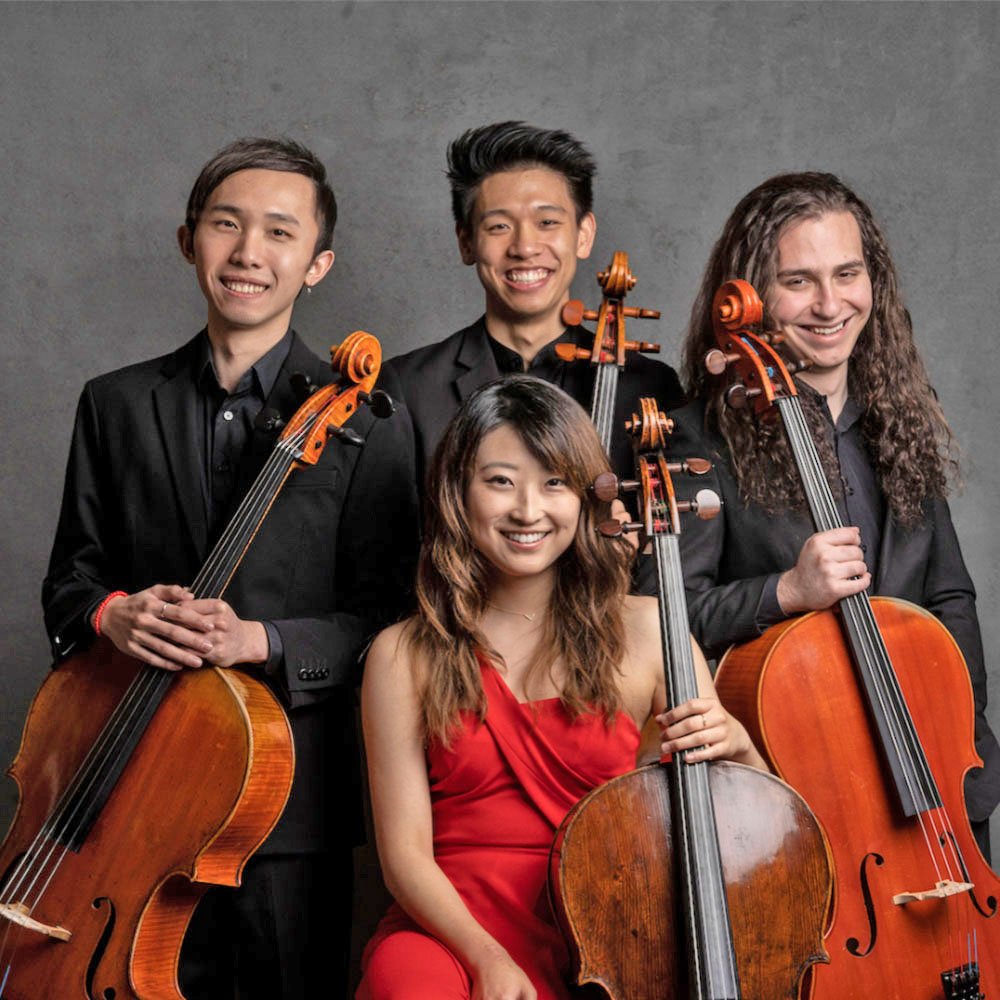
Due to the lack of repertoire as noted above, the concert consisted almost entirely of arrangements, save for the commissioned work and one other. All their repertoire, again save for the newly commissioned work, was committed to memory. Vivaldi’s final Presto from the “Summer” concerto of The Four Seasons received a virtuosic reading at top speed, the cellists’ solid in their tone and interpretation, with perfect intonation that never wavered even in the highest registers. The gave Mozart’s Sonata in D Major for piano four hands K. 381 in its entirety, the first two movements expressing sheer elegance, while the final one again showed off the group’s brilliance. A similar range of interpretation pervaded Beethoven’s 12 Variations on a Theme from Handel’s Judas Maccabeus, originally written for piano with cello accompaniment. Soothing sounds prevailed for Debussy’s Reverie and Tchaikovsky’s Andante Cantabile, while highly aggressive attacks pervaded the virtuosic music of Paganini’s Variations on a Theme by Rossini, in the Galvin’s own arrangement.
The only casualty thus far was a single bow hair, although a cello string had to be replaced in the second half, which opened with Carlos Gardel’s quintessential tango Por una Cabeza, which has been arranged by and for several famous musicians in the classical world, followed by excerpts from Mussorgsky’s Pictures at an Exhibition in an arraignment by Principal Cellist of the Boston Symphony Blaise Dejardin. A striking feature of all the arrangements presented was the unique and dynamic interplay among the four cellists, lines equally distributed so that each player gets to play in all registers. Dulcet highs, clear harmonics, resonant low notes, and warmth of tone from the tenor range was demonstrated by each player, and while all parts were equal, the players still rotated their seats for each piece.
The final two pieces on the program were both commissioned specifically for the Galvin, the first being the Derksen, and the final work being commissioned by the foursome. Forrobodó was described as a party dance by the Brazilian member of the group, Luiz Fernando Venturelli, who praised its composer André Mehmari as a renowned pianist and a big influence on himself and many other students of classical music. It’s festive Brazilian rhythms, depictions of the berimbau, a bow string instrument of African descent, popular in Brazil, warm melodies and lush harmonies bid us all a good night.
Upcoming festival concerts this week include Broadway star Jessica Vosk, the Palaver Strings exploring folk music from around the world, chamber music quintets, harp and piano recitals, a celebration of Rave@ 150, and on Saturday a David Lang US Premiere by the Attaca Quartet, with Bartok and Mendelssohn also on the program. View the full season HERE.
Another recent BMInt review of the group is HERE.